
God Is Not Unrighteous to Forget
I. The butler
Joseph interprets a dream in prison. The chief butler, held there with him after offending Pharaoh, will be restored to Pharaoh's table within three days. Joseph asks for one thing in return. "Think on me when it shall be well with thee, and shew kindness, I pray thee, unto me, and make mention of me unto Pharaoh, and bring me out of this house." (Genesis 40:14)
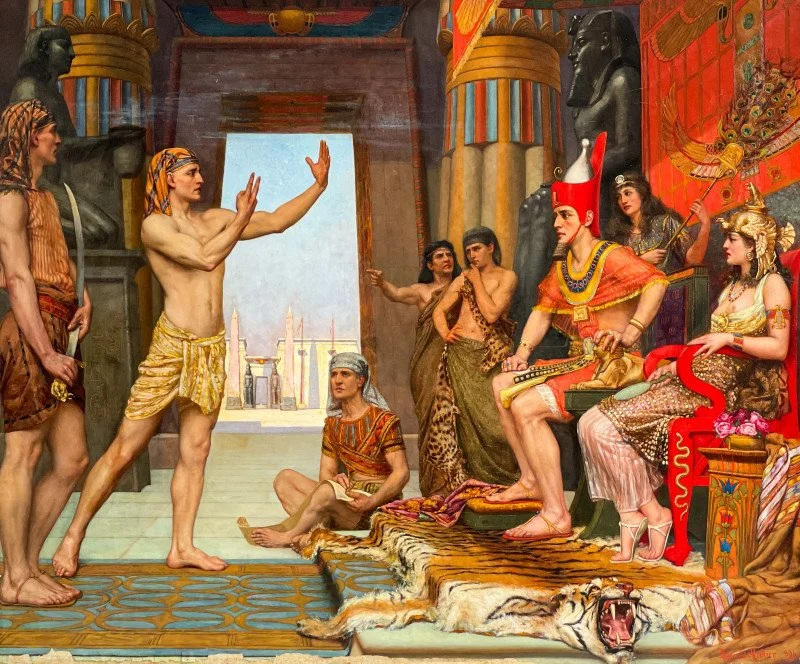
Reginald Arthur, Joseph Interpreting Pharaoh's Dream (1894)
The butler is restored exactly as foretold. And the chapter closes with one of the flattest sentences in Genesis: "Yet did not the chief butler remember Joseph, but forgat him." (Genesis 40:23)
Two full years pass. Then Pharaoh has a dream that nobody at court can read, and the butler recalls a Hebrew in the prison who could. Genesis does not say why he remembered. It records when: two years on, at the moment the man he had forgotten became useful.
Joseph's request is timed. He does not ask to be remembered here, in shared adversity, where the butler is grateful and has nothing else to think about. He asks to be remembered there, when it shall be well with thee. The kind of remembering is specified too. Not a private thought. "Make mention of me unto Pharaoh." Joseph wants to be named in the one room where naming him would cost the butler something, and that is the room where the butler goes silent. Whether Joseph foresaw the lapse, Genesis does not say. It only records that the lapse came exactly where the request was aimed. It happened when things levelled.
There is a stranger layer in the story than the moral one. The silence ended on the morning Pharaoh needed a reader, and Joseph later gives his own account of the whole sending, the sale and everything after it: "God did send me before you to preserve life." (Genesis 45:5) The butler's two years sit inside that sending. That does not make the forgetting good. It means the wrong done to Joseph and the good done through Joseph were held in the same hand.
II. A king which knew not Joseph
The same Joseph who saved Egypt is the subject of the next great forgetting. "Now there arose up a new king over Egypt, which knew not Joseph." (Exodus 1:8) The whole apparatus of Israel's bondage begins in that clause. The narrative places the lost memory first. A new king arises who does not know the man who stored the grain, and almost immediately the descendants of that man are being accounted for as a danger. The memory that lapsed was Egypt's, not one man's; the king inherited a kingdom that had stopped carrying the name.
In the next verse, the king is speaking, and he is not silent about the Hebrews. He is revising them. "Behold, the people of the children of Israel are more and mightier than we: come on, let us deal wisely with them." (Exodus 1:9 to 10) Something real had changed. Two verses earlier we are told Israel had multiplied and filled the land. What changed in Pharaoh was the account of what those numbers meant. The descendants of the man who fed Egypt through seven years of famine are recast, in a single sentence, as a security problem, and the account changed in the direction that made the forgetting look like prudence.
Forgetting is what happens when the memory lapses. Revising is what happens when the memory will not lapse and must be dealt with. The memory that would not lapse in Egypt was not the king's. It was the debt itself, still standing in the land in the form of a people too many to overlook. One reason people rewrite the past is that an old dependence sits badly inside a new account of themselves, so the story is edited until the debt is small enough to ignore or, better still, until the creditor is the one at fault. "Let us deal wisely with them" is the language of a ruler converting inherited obligation into present risk. The old service has disappeared from the account. Only the present liability remains, and it needs a reason.
The pattern repeats after Gideon. He delivered Israel from Midian, refused the crown, and died in a good old age. Then, in two consecutive verses: "the children of Israel remembered not the LORD their God, who had delivered them out of the hands of all their enemies on every side: neither shewed they kindness to the house of Jerubbaal, namely, Gideon, according to all the goodness which he had shewed unto Israel." (Judges 8:34 to 35) The narrator puts them side by side. Forgetting the LORD and forgetting the man through whom he delivered them are one lapse in one breath, and the second is measured against the goodness received. Israel had stopped keeping the account. Scripture had not.
III. Where are the nine?
Ten lepers cry out to Jesus from a distance. He sends them to the priests, and they are cleansed as they go. One turns back. "And Jesus answering said, Were there not ten cleansed? But where are the nine?" (Luke 17:17)
They had obeyed the instruction to go. What Jesus marks is that only one returned to give glory to God. Their healing was complete, their lives were handed back to them, and the handing back itself carried them away from the one who did it. The gift becomes the reason the giver is not thanked, because the gift gives the receiver somewhere else to be.
IV. Lest thou forget
Moses saw this coming and said so at length. Deuteronomy 8 is not a warning to people in difficulty. It is a warning to people doing well. "Lest when thou hast eaten and art full, and hast built goodly houses, and dwelt therein; and when thy herds and thy flocks multiply, and thy silver and thy gold is multiplied, and all that thou hast is multiplied; then thine heart be lifted up, and thou forget the LORD thy God, which brought thee forth out of the land of Egypt." (Deuteronomy 8:12-14)
Fullness first, then the lifted heart, then the forgetting. Moses does not treat the forgetting as a rare failure. He sets it in the ordinary sequence of prosperity, a sequence prosperity can set running if it is not deliberately interrupted. And in Deuteronomy 8 the thing forgotten is always the same: "which brought thee forth." The origin. The hand that did the carrying.
So Moses does not leave remembrance to feeling. The command is "remember," which is a practice. "Thou shalt remember the LORD thy God: for it is he that giveth thee power to get wealth." (Deuteronomy 8:18) Remembering is work. And if it would be unrighteous in God to forget, then remembering is a righteous practice, which is why Moses could command it.
V. The record is not lost
"For God is not unrighteous to forget your work and labour of love, which ye have shewed toward his name, in that ye have ministered to the saints, and do minister." (Hebrews 6:10)
To forget the labour of love would be unrighteous, and God is not unrighteous. The record, in other words, is not lost. Not by the butler. Not by the nine. Not by the house of Israel after Gideon died. It is held by the one witness who was in the room when the carrying was done, and nothing was said about the weight. This is not a claim we hold against God. It is a claim about his character, and it rests on his faithfulness rather than on anything we have earned.
Jesus puts the smallest entry on it. "Whosoever shall give to drink unto one of these little ones a cup of cold water only in the name of a disciple, verily I say unto you, he shall in no wise lose his reward." (Matthew 10:42) A cup of water. The thing so small the receiver would not remember it by nightfall.
Malachi gives the divine remembering an image. "And a book of remembrance was written before him for them that feared the LORD, and that thought upon his name." (Malachi 3:16) A book of remembrance. The very thing the butler did not keep.
The labour Hebrews has in view is labour toward his name, ministered to the saints. Whether carrying a person quietly is that, the verse does not say, and I am assuming it. The cup of water puts the smallest carrying on the record, on the same condition: it is given in the name of a disciple. Both verses ask what the giving was for. The consolation runs only as far as that answer.
VI. Them that honour me
Genesis names what the butler failed to do as remembrance and kindness. Scripture has another word for a related refusal, though it does not use it there, and it is worth knowing what the word weighs.
The Hebrew for honour is kabed, and its root meaning is weight. To honour someone is to let them be heavy in your account, to give their contribution mass. The opposite of giving weight is making light. In the sentence God sends to Eli, the priest whose house had been given everything, the act is despising, bazah, and the judgment is qalal: "them that honour me I will honour, and they that despise me shall be lightly esteemed." (1 Samuel 2:30) Eli's failure was not that he cursed God. It was the charge God lays in the verse before: "honourest thy sons above me" (1 Samuel 2:29), his own house growing fat on the chiefest of the offerings while the giver was made light. The sentence on his house is that the weighing will be returned in kind. Honour makes heavy. The verdict makes light. That is the shape of the butler's silence, whatever word Genesis uses for it.
And the promise runs the other way. God does not say he will repay those who honour him. He says he will honour them. He will give them weight.
The verse is about honour due to God, and Eli's charge shows the two honours are ordered, not one: he honoured his sons above God. Honour to God is the account. Honour to people is how the entries are made, and an entry may not exceed the account. But it is made there. "He that oppresseth the poor reproacheth his Maker: but he that honoureth him hath mercy on the poor." (Proverbs 14:31) The verb is kabed. The verse is about the poor, not about benefactors; what it shows is the direction of the traffic. Honour to God is paid, in that verse, through a man. Eli's sons dishonoured God by what they did to the people bringing offerings. The texts refuse to seal honour to God off from what is done to people, and the butler's silence toward Joseph belongs inside that refusal, not outside it.
VII. The names at the end of the letter
If God keeps the record, two things follow, and they pull in opposite directions.
The first is that we are released from keeping it ourselves. I say this as someone who has kept it, and who has carried people who did not remember the weight. The sting of that is real, and Scripture does not pretend otherwise. Jesus asks where the nine are. Paul names Demas (2 Timothy 4:10). Lament is not unbelief. But there is a point where the forgotten benefactor begins to believe that an unacknowledged good is therefore a lost good, and at that point the bitterness becomes a kind of unbelief, because it assumes the only record that matters is the one the butler failed to keep. Hebrews 6:10 says otherwise. Their failure to recognise what you gave does not have to make recognition a condition of everything you give afterward.
This is not a command to keep carrying a particular person; deciding not to is judgment, not unbelief. And the record God keeps of what you gave is not a licence to keep your own record of what you were owed. The servant who was forgiven a great debt and then held his fellow to a small one (Matthew 18:32 to 33) is the picture of that second ledger, and it is condemned. The fellow servant's debt was real; that is what makes the parable hard. Forgiveness is asked of a true account, not an imagined one. Lament may name the missing return, as Jesus did with the nine and Paul with Demas. It may not go on collecting. That is the ledger of what you were owed. The record of what you contributed is a different account, and nothing here asks you to burn it.
The second is that we are not released from keeping it for others, and here the knife turns the other way. I am very good at remembering the people who forgot what I did for them. I am far less reliable about the people who did the same for me. Memory is asymmetric, and it runs the way Deuteronomy says fullness runs: away from the origin.
Paul, who writes that "all they which are in Asia be turned away from me" (2 Timothy 1:15), does not respond by keeping his gratitude to himself. The next verse is Onesiphorus: "for he oft refreshed me, and was not ashamed of my chain." (2 Timothy 1:16) Paul spends most of the last chapter of Romans naming people. Priscilla and Aquila, "who have for my life laid down their own necks." (Romans 16:4) Phoebe, "a succourer of many, and of myself also." (Romans 16:2) Here was a man whose commission did not depend on a human patron, called directly on the Damascus road, and he still could not close that letter without listing the people who had carried him.
That is what remembering as a practice looks like when it is turned toward the people who carried you. Not the feeling of gratitude but the naming of names, done in writing, done in public, done while it is well with thee. It is giving weight to the people who carried you in the one room where the weight costs you something.
The butler remembered when he needed Joseph. Paul remembered while it was well with him. Only one of them is the pattern.
Scripture quoted from the King James Version.